domingo, 10 de septiembre de 2023

"Areas that hadn't been discovered": Asmus Tietchens (Ger) – Seuchengebiete 2 (1991) - REVIEW

Asmus Tietchens (Germany) – Seuchengebiete 2 (1991) CD / Syrenia

[English first, Spanish one below]

“I am an adventurer in the studio. For hundreds of years there were maps with dots or points that indicated areas that hadn’t been discovered. My aim is to discover the white dots on the landscape of sound, territories where no other has travelled” - A.T., Unsound Magazine (1985). 

    Asmus Tietchens managed to teach acoustics in Hamburg despite having no studies or academic training. He got Peter Bauman, a member of Tangerine Dream during most of the 70s, to produce his first LP, Nachtstücke, thanks to being a part of the German electronic music circle.
    All I know about Asmus (born 1947) is limited to his Dämmerattacke (1997) (please, do listen the first track on this album) and the present work. However, the following description taken from Discogs sheds more light on the subject: “Tietchens is a German electronic musician who has pursued "absolute music" through an almost mathematical process of rigid formal exercises. With strong ties to Karlheinz Stockhausen's early electronic work, Tietchens specializes in irregular patterns of sonic abstractions that are suspended in gray drones to create cold textural voids from external references. His music is often inspired by and refers to the texts of the philosopher Emil Cioran.” Thus, it is not for nothing that the booklet of this album includes a fragment of his History and Utopia.
    This present album, though, still goes on with his “hydrophonies” - such is the title of these tracks, something he had already done in his albums Formen letzer Hausmusik (1984) or Seuchengebiete (1985), none of which I have yet listened. Concerning the sound, Hydrophonie 13’s intro could easily fit the soundtrack of Alien (1978) or the recording of some takes of the Deep Ones in The Shadow over Innsmouth. You can make out the sound of water, as well as some synth/fx details that are quite successful. Just to make it clearer, it isn’t simply a dungeon synth track, always insisting on the same notes. Hydrophonie 8 is closer to that patter of the water on a metallic sink, similar to the ones you would find in a jail or in public spaces, but with the ability to adjust the stream, without leaving out some fx. Hydrophonie 11, on the other hand, features a minimal flow of water (sponsored by the Spanish campaign “Each drop counts”?), comparable to strong gusts of wind or some powerful sound background that makes it difficult for you to make out different voices and sounds.
    I might be blowing things out of proportion here, but, after listening to Hydrophonie 12 I wonder: has no one ever thought about how alienating it is to listen to water flowing and falling onto a sink, particularly if the latter is metallic? Isn’t it one of the most dehumanizing, inert daily details? You can also hear water splashing its own puddle, with some synth and musical fx on the background. I really like his attention to detail, as well as his abstraction to be able to create such a thing. It is really cool, I think it’s carefully chosen and well thought. This is the context, the amplification of the water flow, the aforementioned attention to detail, where, by revisiting Hydrophonie 11, we come to find multiple water channels, containing the one we referred to prior (the water pattering on the metallic sink) in parallel with a background noise. That’s where I start immersing myself in this track, obsessing, “empathizing”, feeling like I belong in the water that is flowing and void, void, void, lifeless void, as if I was riding one of Euronymous’ riffs in the De mysteriis dom Sathanas, as some people call MayheM’s album. 

Wether it belongs or not with the way it was recorded, text and drawing taken from Unsound magazine, 

published in 1985, we don’t know the issue. Thanks to Selfish Stew blog for sharing so much stuff.


There are other works that feature water or make “music” with it, but this is the only one I know. I think I recall Damien de Coene had a similar work within the boundaries of the HNW genre, idk. They are interesting, both the concept and the stuff itself. I really don’t know whether one could lead a frugal life revolving around Cioran’s texts since I haven’t read them, but I do believe it is possible with this album - especially with the first track, Dämmerattacke. This and the field recordings have made me see faucets, toilet flushings and drainpipes in a different light. It’s pretty cool and interesting, in my honest opinion. There’s not  much more to add, except for saying that this album is 57 minutes long, that this work isn’t for everyone that wants to change his frame of reference or hate this fanzine and blah, blah, blah. This won’t be the last thing I will listen from him.
Originally published in I Don't Give a Fuck IV "bookazine"
________________________________

[ESP]

Soy un aventurero en el estudio. Durante cientos de años hubo mapas con puntos que indicaban zonas que no habían sido descubiertas. Mi objetivo es descubrir los puntos blancos en el paisaje del sonido, territorios donde ningún otro ha viajado.
- A.T. // Unsound magazine (1985). 
 

Sin estudios en la materia o formación académica, el presente autodidacta llegó a enseñar acústica en Hamburgo. Cercano al círculo de la electrónica alemana, su primer LP, Nachtstücke, será producido por Peter Bauman, miembro de Tangerine Dream durante gran parte de la década de 1970.
    Mi conocimiento de Asmus (n. 1947) se reduce a su Dämmerattacke (1997) (por favor, escuchad el primer tema de ese disco) y a este trabajo. Sin embargo, la presente descripción sacada de Discogs arroja más luz sobre el asunto: “músico electrónico alemán que ha perseguido la ‘música absoluta’ a través de un proceso casi matemático de rígidos ejercicios formales. Con fuertes lazos con los primeros trabajos electrónicos de Karlheinz Stockausen, Tietchens se especializa en patrones irregulares de abstracciones sónicas que se suspenden en drones grises para crear fríos vacíos de textura a partir de referencias externas. Su música a menudo se inspira y hace referencia a los textos del filósofo Emil Cioran”. No en vano, en el libreto de este disco se incluye un fragmento de su Historia y Utopía.
    Mas el presente disco continúa con sus “hidrofonías”, título que llevan estos temas, algo que ya había hecho anteriormente en Formen letzer Hausmusik (1984) o Seuchengebiete (1985), los cuales no he escuchado.
    En cuanto a lo que suena, la Hydrophonie 13, con esa intro, podría encajar en algo del estilo Alien (1978) o yendo de visita a grabar unas tomas de los Profundos en La sombra sobre Innsmouth. Se percibe el sonido del agua, así como detalles de sintetizador/efectos bastante bien logrados. Por introducir una referencia más cercana en el tiempo, no es un rollo sintetizador a lo Dungeon Synth fusilando las mismas notas. La Hydrophonie 8 ya está más cercana a ese rollo de golpear en una pileta metálica, como esas de la cárcel o de las fuentes públicas, pero pudiéndose regular el chorro, sin obviar algunos efectos. Por otra parte, en Hydrophonie 11 es casi un chorro mínimo (¿patrocinado por campañas de “Cada gota cuenta”?) como cuando hay ráfagas de viento fuerte o de algo potente a nivel auditivo y te cuesta distinguir/discernir determinadas voces y sonidos.
    Con la llegada de Hydrophonie 12, ya no sé si estoy deformando las cosas, pero ¿nadie se ha parado a pensar en lo alienante que resulta escuchar el agua correr y caer contra un lavabo, particularmente uno metálico? ¿No es una de las cosas más alienantes e inertes dentro de los detalles cotidianos? Y después se va escuchando al agua salpicando su propio charco, además de añadirle algún efecto con el sintetizador/musical de fondo. Realmente me gusta su atención al detalle, así como su abstracción para llegar a realizar algo así. Realmente me mola, creo que está bien medido y bien pensado. Y es en este detalle de la precisión, del aumento de la misma, de la importancia al detalle donde, revisitando Hydrophonie 11, notamos varios canales de agua, la que baja golpeando la pileta metálica ya referida, en paralelo con otro ruido de fondo. Y es cuando me meto en este tema que me obsesiono, “empatizo”, me siento parte del agua que se va y vacío, vacío, vacío, sin vida, como cabalgar sobre un riff de Euronymous en el De mysteriis dom Sathanas, como se tienen referido por ahí al disco de MayheM. 

Se corresponda o no con la forma de la grabación, texto y dibujo tomados del magazine Unsound, 

editado en 1985, desconocemos el número. Gracias al blog Selfish Stew por compartir tantísimo material.

Existen más trabajos grabando agua o haciendo “música” con ella, pero de ahí a que los conozca, solo este. Incluso creo recordar que Damien de Coene tenía algo semejante pero llevado al ámbito del HNW, idk. Me parecen interesantes tanto el concepto como la movida. Desconozco si a través de los textos de Cioran, pues no los he leído, mas creo que se podría llevar una vida frugal en torno a este disco, pero en especial, con el primer tema del referido Dämmerattacke. Entre esto y las grabaciones de campo, no he vuelto a ver los grifos o la cisterna del water o los desagües de la misma manera. A mi parecer, está bastante chulo e interesante. Y poco más que añadir, salvo que son cincuenta y siete minutos en total y que no es para cualquiera cualquiera que no quiera romper su marco de referencia u odiar este fanzine y bla, bla, bla. No será lo último que escuche de él.

Originalmente publicado en I Don't Give a Fuck IV "bookazine".

martes, 3 de mayo de 2022

Sete Star Sept (Jap) & Rich Hoak (USA) - Electroencephalogram (2019) - REVIEW

Disclaimer: originally written for and published in IDGF IV issue. 
Spanish written below.

Sete Star Sept (Jap) & Rich Hoak (USA)

- Electroencephalogram (2019)

Colaboration tape / P2

"You are G, bro!” is a slang term you can hear on the street or in different Eazy-E tracks, because it means “gangsta”. At the same time, though, could it refer to a “gentleman”? It is a tough call to decide which one of the two expression fits what follows.

A total of twelve minutes that start  flat out and extra noisy, fitting in some Richard and Kae’s yells throughout. It’s when six minutes have gone by that they start relaxing a bit and Richard and his saxophone start playing more “normal” and chill stuff, closer to 40s and 50s jazz.

I can’t help but picture them playing in a futurist distopia, like Fallout New Vegas. Yes, I mean that videogame that takes place in Mojave’s desert, US, in 2281, in the aftermath of a nuclear holocaust. The thing is, they are playing at thus pub, which is a motel/inn at the same time; robots are patrolling the streets, you can even have sex with them, but you might lose your tongue because you have put it in a place you shouldn’t have; even in a party, a quick withdrawal is a victory sometimes. That’s when the “normal” sax part kicks in and, in places where the videogame tries to emulate the atmosphere of 50s America, you find a sweaty Frank Sinatra among the public, watching Kae yell, playing bass and screaming with an artificial leg to be able to stand up.

I love their atmosphere. They remind me of Peter Brötzmann’s abrasion or works like Pakistani Pomade. However, in spite of that influence, it really feels like the aforementioned bands had just discovered Japanese noise and had ended up solidifying their relationship by collaborating with SSS, getting closer to noisecore. Jazz, noise and free jazz influences are there, but the “closest” comparison to this one is Spastic Burn Victim’s Fuck your Eyes (2014), where Colin Webster plays sax as a guest. Regarding the differences between them both, this one is sometimes more savage, cacophonic and sharp - to which the production contributes immensely. The other one doesn’t fall behind, even more so seeing as C. Webster is a professional sax player and he is at an advantage.


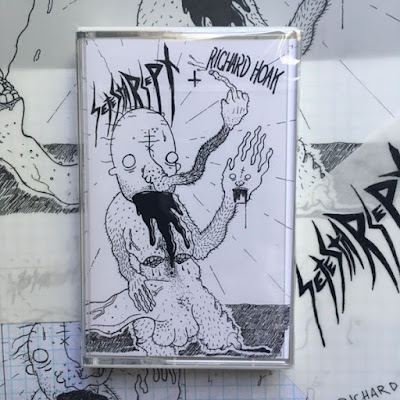
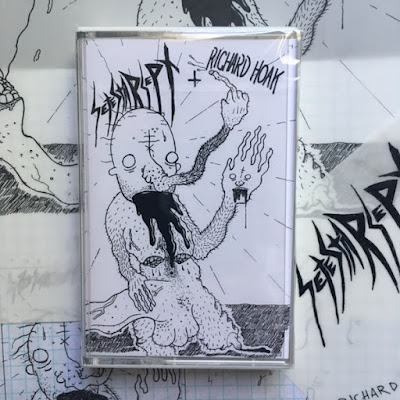
“Recorded and Mixed at Grindlabs (Philadelphia, PA) on 04/09/18”  // Pic @p2loggia

However, this is not just about knowing how to play, but also about attitude. The uncleanliness of Richard’s drum playing is not an exception, and he transfers it to the sax; therefore, I can’t help but think (while smiling) that he might make the same faces playing like the ones you see in the Brutal Truth’s videoclip Sugar Daddy.

Despite their abrasive sound being the greatest virtue, it constitutes its major flaw as well. I dig free jazz a lot (even if I don’t know a lot about it because it is extremely dense) and I’m missing nuances, more notes, more changes, etc. It seems more like a jam session than anything - even though, I quite like it. I like that hybridisation with noisecore. The “biggest problem” lies in trying to listen to it constantly, because we are couth rats. Playing this album is one thing, but listening to it live, being able to tip them with some coins in their hat while they play in the streets of a tourist city (so that they could pay their fine for public scandal) or something of the sort  would be way better.

I would love to give production and sound some credit. It is quite loud and abrassive, it seems like a good move. Their stridency makes me think of the idea of them collaborating or a live streaming with Petr Válek, this Czech guy that makes really noisy videos with random houseware, instruments, machinery or anything he lays his hands on, not giving a fuck about anything or anyone. What if he collaborated with him or with Changoz! soon? :D I crave for more, and I would love to see him live, to be invited to their recording studio, or for someone to make a bootleg like the “deadheads”, or for someone to make hippy t-shirts with this work’s cover.

Finally, I love the artwork, done by The American Flag. No fucks given, 10 out of 10. I would love to mention the Italian label P2, the ones in charge of editing them, for they did a great job as propagandists: “We really don't know what to tell you but there's a big chance you're not going to be able to handle this. That's not a challenge, it's a fact.” They are not far wrong there, but as with Naked City, this might be some people’s introduction into disliking and following jazz paths. Give it a go, even if it just makes you being kicked out of home. //

https://shop.7s7.org/album/electroencephalogram  https://p2loggia.bigcartel.com/products 


Sete Star Sept (Jap) & Rich Hoak 

(USA) - Electroencephalogram (2019)

Colaboration tape / P2

"You are G, bro!” es una expresión slang que puedes escuchar en la calle o en diferentes temas de Eazy E, pues hace referencia a “gangsta”. Pero, al mismo tiempo, ¿podría hacer referencia a ser un “gentleman”? Es difícil escoger una de las dos expresiones para lo que sigue.

Doce minutos en total, que empiezan a todo trapo y súper ruidosos, intercalando berridos de Kae y Richard por el medio; pero, es en torno a los seis cuando se empiezan a relajar un poco y Richard y su saxofón empiezan a hacer cosas más “normales” y tranquilas, donde parece más cercano al jazz de los años 40s-50s.

No puedo evitar imaginármelos tocando en una distopía futurista, como el Fallout New Vegas. Sí, el videojuego ese ambientado en el desierto del Mojave, USA, en el 2281, tras un holocausto nuclear. El caso es que se encuentran tocando en un pub, que a su vez es motel/posada, y algunos robots patrullan las calles, o incluso puedes tener sexo con ellxs, pero pierdes la lengua por meterla donde no debes, ya que, incluso de fiesta, una retirada de tiempo es una victoria. Y ahí llega la parte “normal” del saxo – y como el videojuego toma aspectos de la América de los 1950s para ambientarse – te encuentras con Frank Sinatra sudando entre el público, viendo a Kae gritar, tocando el bajo, y berreando con una prótesis en su pierna derecha para mantenerse de pie.

Me mola su atmósfera. Inicialmente me recordaron a la abrasión de Peter Brötzmann o a trabajos como Pakistani Pomade. Sin embargo, pese a que la influencia pueda estar ahí, suenan como si las referidas bandas descubriesen el noise japonés y terminasen apuntalando su relación colaborando con SSS, acercándose más al noisecore. Las influencias del jazz, el noise y el free jazz están ahí, pero, quizás, lo “más cercano” con que puedo compararlo, es con el Fuck your Eyes (2014) de Spastic Burn Victim, donde Colin Webster toca el saxo como invitado. Sobre las diferencias entre ambos, esto es a ratos más salvaje, cacofónico y afilado, a lo cual también ayuda mucho la producción. El otro tampoco se queda atrás, sumado a que C. Webster es un saxofonista profesional y juega con ventaja.


 “Recorded and Mixed at Grindlabs (Philadelphia, PA) on 04/09/18” // Pic @p2loggia

Pero esto no se trata solo de saber tocar, sino también de actitud. La suciedad que tiene Richard tocando la batería no es una excepción, y la lleva también al saxo, por lo que no puedo evitar pensar – y sonreír – pensando en si pone las mismas caras que cuando toca, como se ve en el videoclip de Sugar Daddy de Brutal Truth.

No obstante, si lo abrasivo que suena es su mayor virtud, también es donde creo que recae su mayor defecto. Le pego bastante al free jazz – y aunque todavía no tenga ni puta idea al respecto porque es súper denso – aquí echo de menos matices, más notas, más cambios, etc. A decir verdad parece una improvisación, la cual está bastante bien, ¿eh? Me gusta esa hibridación con el noisecore. El problema es querer quemarlo a escuchas, quizás es aquí donde surge el “mayor problema” porque somos unas ratas exquisitas. Mola ponerse el trabajo, pero molaría mucho más tener la posibilidad de verlo en directo, o dejarles limosna en un sombrero de cualquier calle de una ciudad turística y que puedan pagar su multa por escándalo público, o algo semejante.

Mención a la producción y el sonido. Suena bastante alto y abrasivo, me parece un gran acierto. Es con la ya referida estridencia que me los imagino haciendo una colabo o un streaming con Petr Válek, el checo éste que hace vídeos súper ruidosos, que tan pronto te pilla cacharros, o instrumentos, o máquinas, o lo que encuentra por casa, sudando de todo y demás. ¿Una colabo en breves con él o con Changoz!? :D Me quedo con ganas de más y, si es posible verlo en directo, que me inviten al estudio de grabación, o que alguien haga un bootleg como los “deadheads”, o diseños de camisetas hippies con la portada de este trabajo.

Por otra parte, el artwork me encanta. Es melasuda total, 10 de 10. Mención especial al sello italiano P2 – quienes lo editan – por su labor como propagandistas: We really don't know what to tell you but there's a big chance you're not going to be able to handle this. That's not a challenge, it's a fact.” No se desencaminan demasiado, pero al igual que Naked City, quizás esto pueda ser la introducción de la gente hacia el disgusto y los caminos del jazz. Dadle un chance, aunque sea para que os echen de casa. // https://shop.7s7.org/album/electroencephalogram https://p2loggia.bigcartel.com/products


IDGF 005 - NABEG - All rights revoked!!!

  IDGF 005  NABEG - All rights revoked This is jazz grind, experimental space rock / Noisecore  and it doesn't suck  -  gabalgabow This ...